
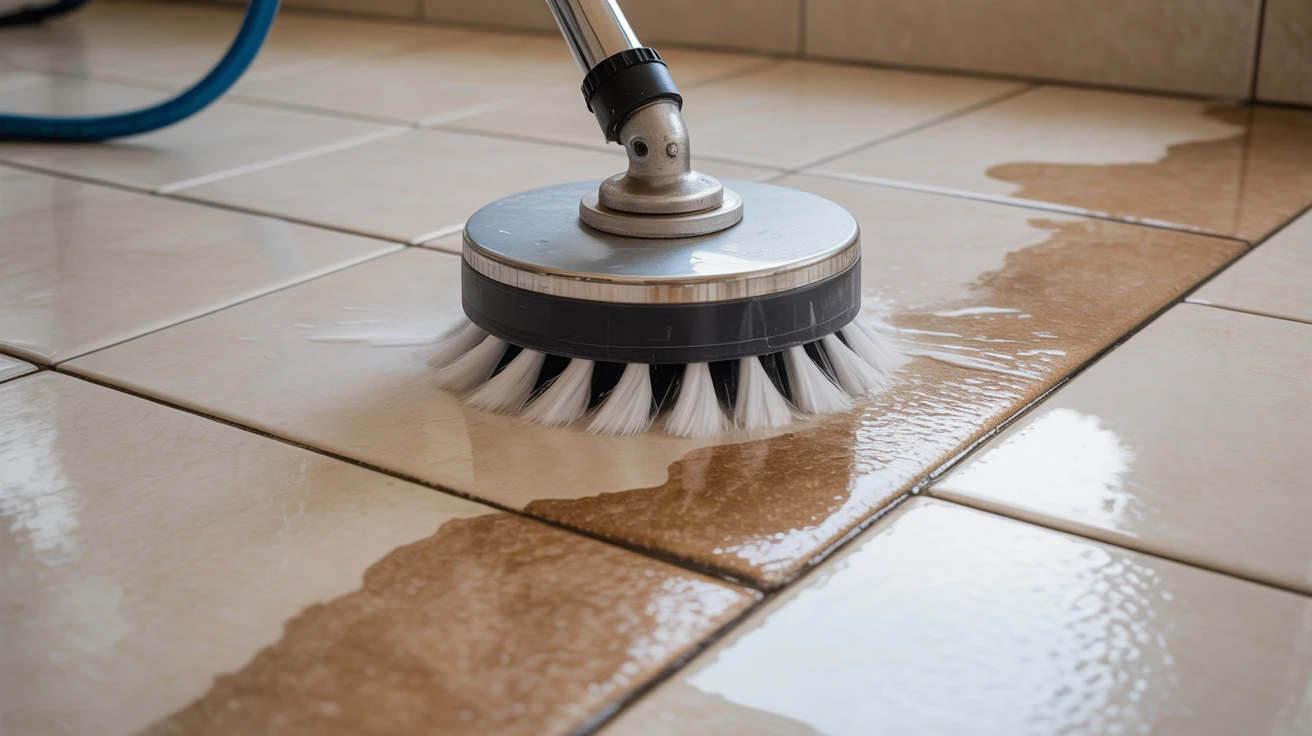
A practical guide for Melbourne facility managers on when hard floors need stripping and sealing, how the process works, what it costs to neglect, and how to choose a provider.
What Floor Stripping and Sealing Actually Means
For facility and building managers, "stripping and sealing" is often used loosely, so it helps to be precise. Stripping is the controlled removal of old, worn sealer and accumulated polish from a hard floor, taking it back to a clean, bare surface. Sealing is the application of fresh protective coats that bond to the floor, restore gloss, and shield it from traffic, moisture and spills. Between the two sits a critical neutralising step that most buyers never see but always pay for when it is skipped.
This work applies to a specific family of hard floors common across Melbourne commercial sites: vinyl and VCT (vinyl composition tile), timber, sealed concrete, terrazzo and safety vinyl in kitchens, amenities and clinical areas. Each behaves differently. VCT in a busy foyer may need recoating far more often than sealed concrete in a back-of-house corridor.
It is not the same as a routine mop or scrub. A nightly clean removes surface dirt; stripping and sealing renews the protective system itself. When managers understand that distinction, they stop treating a dull, scuffed floor as a cleaning failure and start treating it as a maintenance cycle that has simply come due. Our dedicated floor stripping and sealing Melbourne service covers each of these floor types across the metro area.
Why It Matters: Slip Safety, Finish Longevity and the Cost of Neglect
The strongest argument for staying on top of floor maintenance is safety. A properly sealed and maintained floor holds a predictable surface, and sealers can be specified to support slip-resistance targets broadly aligned with AS 4586 in wet or high-traffic zones. A neglected floor is less predictable: worn patches, uneven polish build-up and exposed substrate all change how a surface behaves underfoot. In a commercial setting, a single slip claim can dwarf years of maintenance spend.
There is also a straightforward asset-protection case. Sealer is sacrificial. It is designed to take the abrasion of foot traffic, trolleys and grit so the floor beneath does not. Once that protective layer wears through, damage moves into the substrate itself, where repairs are far more expensive than a recoat and sometimes mean full replacement.
Appearance matters too, particularly in client-facing foyers, showrooms and reception areas. A deep, even gloss signals that a building is well run. Dull, patchy floors quietly undermine the same impression, no matter how good the rest of the clean is. For managers, the real cost of neglect is rarely the recoat they deferred; it is the premature replacement, the safety exposure and the tenant complaints that follow.
How Often Melbourne Commercial Floors Need Attention
There is no single interval that suits every site, and any provider who quotes one without seeing your floors should be treated with caution. Frequency depends on traffic volume, floor type, the quality of daily maintenance and the standard you need to hold.
As a working guide, high-traffic VCT and vinyl in foyers, corridors and retail areas often need a full strip and seal every 12 to 24 months, with interim burnishing in between to keep the gloss up. Lower-traffic areas such as private offices or meeting rooms can stretch considerably longer. Sealed concrete and terrazzo are more durable again and may need resealing only every few years, though they still benefit from regular maintenance.
The smarter approach is condition-based rather than calendar-based. Walk the floors quarterly and watch for the early signals: loss of gloss, grey traffic lanes that will not mop out, scuffing that no longer responds to buffing, and any sign of the sealer wearing through to bare substrate. Catching a floor at the burnish-and-recoat stage is dramatically cheaper than waiting until it needs a full strip. A good cleaning partner will track this for you as part of a planned programme rather than leaving it to a crisis.
How the Professionals Do It, Step by Step
A proper strip and seal is methodical, and understanding the sequence helps you judge quotes and supervise work. It begins with preparation: moving or protecting furniture, cordoning the area, posting wet-floor signage and masking skirting, edges and adjacent surfaces that the stripping solution must not touch.
Next comes stripping. A stripping solution is applied and given dwell time, then agitated with a rotary or orbital machine to lift old sealer and polish. The resulting slurry is extracted with a wet vacuum, not just mopped around. This is where the invisible neutralising step earns its keep: the floor is rinsed and pH-neutralised so the new sealer can bond properly. Skip it and the fresh coats will peel, cloud or lift within weeks.
Once the floor is bare, clean and fully dry, sealer is applied in thin, even coats, with each allowed to cure before the next. Multiple coats build durability and depth of gloss; the right number depends on floor type and traffic. Finally, on finishes that allow it, the floor is burnished with a high-speed machine to harden the surface and lift the shine. Done correctly, the whole sequence is as much about chemistry and patience as it is about machinery.
Choosing the Right Provider in Melbourne
Floor restoration is skilled work, and the gap between a good job and a poor one is wide and expensive. When you assess providers, look past the headline price to how they actually operate.
Start with insurance and compliance. Any contractor working on your floors with machinery and chemicals should carry substantial public liability cover; Sparkle Office is insured to $20M and our crews are police-checked and uniformed, which matters in secure and multi-tenant buildings. Ask how long they have been doing this type of work specifically. We have spent more than 15 years cleaning Melbourne commercial sites, with a team of over 50 cleaners and a genuine 5.0-star rating from 79 Google reviews.
Then probe the method. A credible provider will talk comfortably about neutralising, coat counts, cure times and slip-resistance, and will want to inspect your floors before quoting rather than pricing blind. They should be upfront about what your floor type needs and honest when a burnish will do instead of a full strip. Finally, consider whether they can fold floor care into a broader relationship. Sparkle Office also delivers commercial cleaning Melbourne businesses rely on, so your floors are maintained by a team that already knows your site.
Planning the Work Around a Live Operation
The biggest practical worry for most managers is not the floor; it is the disruption. Stripping and sealing needs the area clear and, crucially, needs the sealer to cure undisturbed. Walking traffic onto a curing floor is one of the most common ways a good job is ruined.
The answer is scheduling. Most commercial strip-and-seal work is done after hours, overnight or across weekends so floors are back in service before staff return. Large sites are often done in zones, closing one corridor or wing at a time so the operation never fully stops. This takes coordination, but it is routine for a crew that works around live buildings every day.
Build in realistic drying and cure windows, not just application time, and plan access, security and lift bookings in advance. Clear signage and barriers protect both your people and the finish. It is also worth sequencing floor work with your other scheduled tasks; pairing it with carpet steam cleaning or a broader clean means one coordinated visit rather than several disruptions. For managers running offices, our office cleaning Melbourne teams coordinate the whole programme so floor care, daily cleaning and periodic work all fit around how your building actually runs.
Matching the Right Service to Your Site
Different buildings need different emphases, and a good partner tailors the programme accordingly rather than selling a one-size package. A corporate head office with timber and VCT needs a finish that photographs well in reception and holds up in the lift lobbies. A warehouse or plant has sealed concrete where slip-resistance and dust control matter far more than mirror gloss.
For industrial sites, floor sealing usually sits inside a wider scope. Our warehouse and industrial cleaning teams handle sealed-concrete maintenance alongside the heavier cleaning those environments demand, so the floor work is specified for the real conditions rather than treated as an afterthought.
Suburban offices and strata-managed buildings have their own rhythm, often favouring weekend or early-morning work to avoid tenant disruption. We service clients right across the metro, and the same standards apply whether you are in the CBD or the suburbs; our office cleaning in Malvern and Mount Waverley clients get the identical method, insurance and crew vetting as a Collins Street tower. The point for any facility manager is simple: start from how the floor is used, match the finish and frequency to that reality, and let a planned programme keep it there.
Ready for a Spotless Workspace?
At Sparkle Office, we deliver professional cleaning results across Melbourne CBD, South Melbourne, Fitzroy, Richmond, Carlton, Brunswick, and 20+ surrounding suburbs. Our 50+ trained cleaners use eco-friendly products safe for your staff and the environment.
Get Your Free Quote