
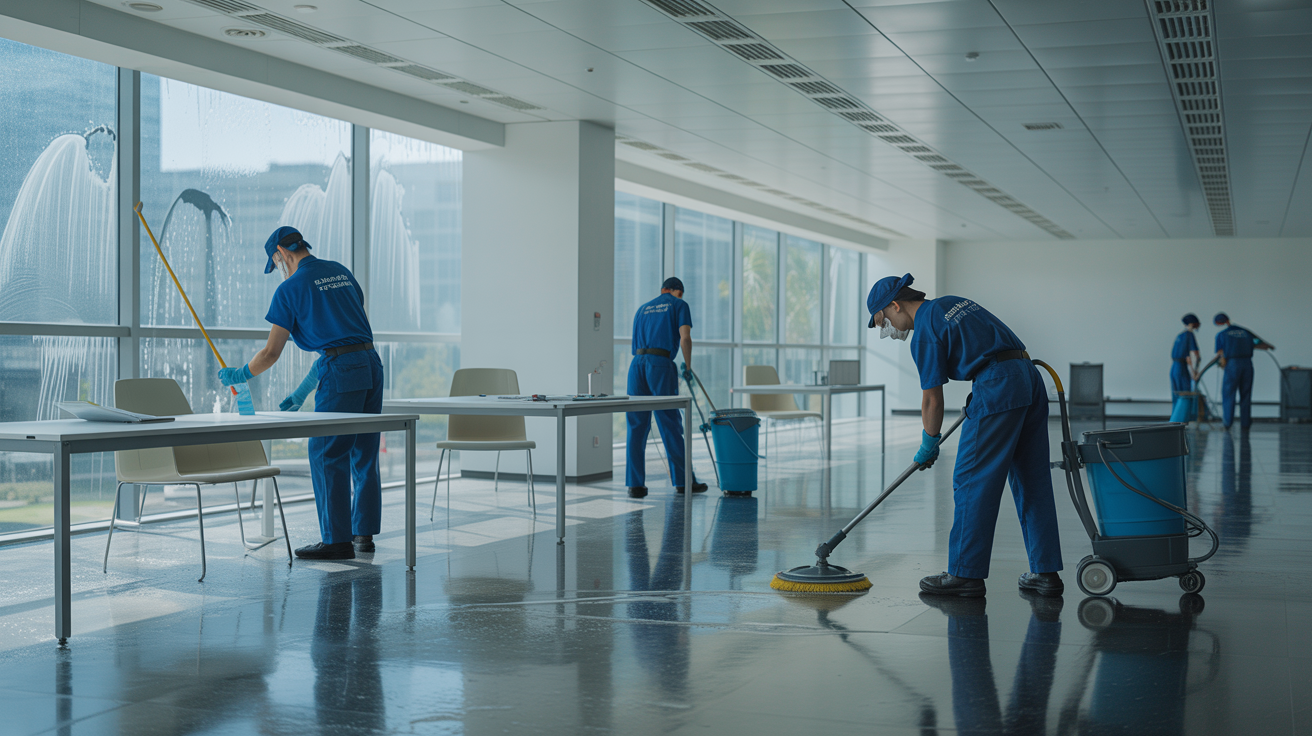
Sweat, shared equipment and humid change rooms make gyms one of the toughest hygiene environments in commercial property. Here is what Melbourne fitness centre operators should expect from a professional gym cleaning program — from equipment sanitisation to wet areas, odour control and 24/7 scheduling.
Why a Gym Is One of the Hardest Hygiene Environments You Will Ever Manage
If you manage a fitness centre, you already know your building behaves differently to an office. An office has people sitting at their own desks, touching their own keyboards, breathing conditioned air at a stable humidity. A gym has hundreds of people per day deliberately raising their core temperature, sweating onto shared surfaces, gripping the same barbells and handles, and then walking into a tiled wet room to shower. Every risk factor that makes a space hard to keep hygienic is present at once.
Start with sweat. It is a constant liquid deposit onto vinyl upholstery, foam grips, rubber matting and steel frames — and it does not evaporate cleanly. It leaves salts and organic residue that feed bacteria and, over weeks, corrode powder-coated finishes and degrade upholstery seams. Then add shared high-touch equipment: dumbbell handles, cable attachments, treadmill rails, console touchscreens, pin selectors, kettlebell grips, spin bike adjusters. In a busy Melbourne club these are touched hundreds of times daily by hands that have just wiped a face or a forearm.
Add direct skin contact. Members lie on benches with bare shoulders and backs, sit on mats in shorts, place their faces near equipment during floor work. This is not incidental contact of the kind you get in a reception area — it is prolonged skin-to-surface contact on equipment that the previous member also used skin-to-surface. That is the transmission pathway behind the fungal and bacterial skin issues gyms are known for.
Finally, humidity. Between showers, steam, sweat and dense human occupancy, a fitness centre runs warmer and wetter than almost any other commercial space. Warmth plus moisture plus organic residue is the exact condition that grows bacteria, mould in grout and biofilm in floor wastes. This is why generic commercial cleaning does not translate. A crew trained on office fit-outs is not trained for this. Gym cleaning Melbourne operators need is a specialist discipline: correct chemistry, correct dwell times, correct sequencing, and a scope that assumes contamination rather than hoping for it.
What Members Actually Notice — And Why It Decides Your Retention
Here is the uncomfortable commercial truth: your members cannot evaluate whether your surfaces are microbiologically clean. They evaluate whether the gym feels clean. And that perception drives renewals, referrals and your Google rating more directly than almost anything else you spend money on.
What they notice, in rough order of impact:
Smell. It is the first signal, and it registers before they have taken ten steps inside. A stale, sour note near the free weights or a damp smell in the change room tells a member the club is not being looked after — regardless of how clean it actually is.
The change room and shower. This is where members are most vulnerable — barefoot, undressed, close to the floor. Hair in a drain, a soap-scummed screen, a bin that was not emptied, a discoloured grout line: these read as neglect and they are remembered.
Visible residue on equipment. Salt tide marks on black vinyl bench pads. Chalky handprints on a console screen. A film on a treadmill deck. Members see this at eye level, while their heart rate is up and they are staring at a surface for thirty minutes.
Mirrors and glass. Smudged mirrors in a weights room are conspicuous because members are looking directly at them the whole session.
The overflowing bin and the empty dispenser. No paper, no soap, no sanitiser wipes, bin full — small failures, loud message.
The reason this matters commercially is that gym membership is a low-friction cancellation. A member who feels the club has gone downhill does not lodge a complaint; they stop attending, then cancel, then post a review that mentions the change rooms. Cleaning is one of the few line items in a fitness centre budget where good performance is invisible and poor performance is publicly reviewed. A professional fitness centre cleaning Melbourne program should be scoped around both realities — the hygiene risk you cannot see, and the perception cues your members judge you on every single visit.
Equipment and Free-Weight Sanitisation: Getting the Chemistry Right
This is where most generic cleaning contracts quietly fail. Gym equipment is an expensive, mixed-material asset — vinyl upholstery, foam grips, powder-coated steel frames, chrome, rubber-coated dumbbells, plastic shrouds and electronic console screens — and the wrong product will destroy it while appearing to do a good job.
The single most important rule: keep bleach and harsh chlorine-based products away from rubber, vinyl upholstery and console screens. Chlorine attacks rubber-coated dumbbells and matting, causing surface degradation and colour loss. On vinyl it strips plasticisers, which is exactly what produces the cracked, split, flaking bench pads you see in tired gyms — a repair bill that dwarfs the cleaning contract. Strong solvents and ammonia-based glass cleaners will also haze and craze the anti-glare coating on treadmill and bike touchscreens.
What should be used instead:
Upholstery and grips: a pH-neutral or mildly alkaline hospital-grade sanitiser confirmed by the manufacturer as vinyl-safe, applied to the cloth rather than sprayed at the equipment, and left for its full label dwell time. Dwell time is the part everyone skips — a sanitiser wiped straight off is a cosmetic wipe, not a sanitisation.
Powder-coated steel and chrome frames: a neutral detergent, then dry-buffed. Standing moisture in weld seams and around bolt heads is what starts corrosion.
Console screens and touch panels: a dedicated screen-safe product on a microfibre cloth. Never spray directly — liquid tracks into the bezel and kills the electronics.
Free weights and racking: dumbbell handles, barbell knurling, kettlebell grips and plate handles are the highest-touch surfaces in the building and the most commonly missed. Knurling traps chalk, skin and sweat and needs mechanical agitation, not just a pass with a wipe. Rack uprights, J-hooks and safety arms get gripped constantly and are almost never in a generic scope.
Sequencing matters as much as chemistry. Clean first, sanitise second. A sanitiser applied over a soil layer is neutralised by that soil and does very little. Proper equipment sanitisation is a two-stage process, and any provider who cannot explain that distinction to you is not doing it. If you would like our recommended product matrix for your specific equipment brands, our team is happy to walk through it — call 03 8610 6350.
Change Rooms, Showers and Wet Areas
Change rooms are where your hygiene reputation is won or lost, and they are the hardest area in the building to keep to standard because they are warm, wet and constantly occupied.
A credible washroom hygiene program should reference the AS/NZS 4146 framework for laundry and hygiene practice where linen and towel services are involved, and apply hospital-grade sanitisers with correct dilution and dwell across all touch surfaces. But standards documents are not the deliverable — a disciplined method is. What that looks like in practice:
Drainage and floor wastes. Floor wastes are the number one source of a persistent change room odour, and they are almost never in a standard scope. Biofilm builds in the trap and grate. It needs a physical clean and an enzyme treatment on a scheduled cycle, not a mop pass over the top of it.
Grout. Grout is porous and it is where soap scum, body oils and mould colonise. Once it darkens, daily mopping will not recover it — it needs periodic restorative work. Building that into the contract as a scheduled deep clean is far cheaper than re-grouting.
Showers. Screens, rails, taps, soap dispensers and the tile-to-floor junction all need attention. Descaling matters in Melbourne, and soap scum is a physical film that requires the right acidic or alkaline product for the build-up type, plus agitation.
Lockers. Inside and out. Handles and latches are high-touch; interiors accumulate damp, hair and residue and are a genuine odour source. A scheduled interior clean-out cycle needs to be in writing.
Benches, hooks, hair dryers, weighing scales, vanity tops and mirrors. All skin-contact or hand-contact, all routinely skipped.
High-touch fixtures. Door handles, cubicle latches, flush buttons, tap sets, dispenser levers — sanitised, not just wiped.
The non-negotiable underneath all of it is colour-coded equipment. Cloths and mop heads used in toilet areas must never travel to the shower area, the vanity or the gym floor. If a provider cannot show you their colour-coding system, they are cross-contaminating your building. Effective change room cleaning is a documented method, not a vague promise.
Odour Control: Neutralise, Don't Mask
Every gym operator has been tempted by the quick fix — a stronger air freshener, a scent diffuser at reception, a citrus mop chemical. It does not work, and members can tell. Fragrance layered over a sour odour produces a distinctive smell that reads as "they are hiding something," and it is worse than the original problem.
Gym odour is organic. It comes from bacteria metabolising the sweat, skin cells and body oils held in porous or absorbent materials — the foam inside upholstery, the backing of rubber matting, carpet in the free-weight zone, grout, floor wastes, locker interiors. Masking fragrance does nothing to the bacteria. It sits on top for a few hours and then the odour returns, now blended with the fragrance.
The method that works is enzyme-based neutralisation. Enzyme and bio-active products break down the organic matter that the odour-producing bacteria are feeding on — removing the fuel source rather than covering the output. That means targeting where the organic load actually sits: floor wastes and drain traps, grout, rubber matting seams and edges, upholstery foam, locker interiors, and the mat area used for floor work and stretching.
Three practical points for operators. First, enzymes need contact time — they are a biological process, not an instant chemical reaction, so they usually run on an overnight or scheduled cycle rather than a quick pass. Second, they must not be applied with, or immediately after, a strong disinfectant, which will kill the enzyme action. This sequencing conflict is a common reason odour treatments fail. Third, odour control is a scheduled maintenance item, not an emergency response — once a smell is established, you are already weeks behind and it is far more expensive to reverse than to prevent.
If your club has an odour you have not been able to shift, it is almost always a drain, a locker bank, or matting — and it is fixable.
Gym Floor Care by Surface Type
Fitness centres typically run three or four different floor systems in one building, and each one is damaged by the correct method for the others. Using a single approach across the whole floor plate is the fastest way to ruin an expensive fit-out.
Rubber matting (free weights, functional zones). The most common gym surface and the most commonly mistreated. Rubber is porous enough to absorb sweat and it hates chlorine and strong solvents, which cause degradation, chalking and colour fade. It needs a pH-neutral cleaner, controlled moisture, and mechanical agitation — sweat and chalk work into the texture and a flat mop simply spreads it. Never flood-mop rubber tiles: water tracks into the seams, sits underneath, and grows what you will later smell. Interlocking tile seams need dedicated attention.
Sprung timber (group fitness, studios, courts). The most expensive and least forgiving surface in the building. Excess water is its enemy — it swells boards, lifts finish and can void a warranty. Timber needs a barely damp method with a manufacturer-approved timber cleaner, and it must not be treated with general-purpose detergent, which leaves a film that turns the floor slippery and creates a genuine injury risk during a class. Grit control matters too: sand and grit tracked in from the street act as abrasive under foot traffic and are what actually wear the finish.
Vinyl and rubber sheet (cardio floors, corridors, reception). Durable and reasonably forgiving, but it shows scuffs and rubber marks from equipment and shoes, and it dulls without a proper maintenance cycle. Neutral cleaner plus scheduled machine work; periodic burnishing or a strip-and-seal cycle depending on the product and traffic.
Carpet and carpet tile (stretch zones, offices, some mezzanines). Absorbs sweat directly. Needs regular vacuuming with a proper filtered machine plus scheduled hot water extraction — this is a major hidden odour reservoir in a lot of clubs.
Entry matting. Underrated and high-value. Grit stopped at the door is grit that never abrades your timber or gets ground into your rubber.
Scheduling Around Members, 24/7 Access and Key Control
An office cleaner shows up at 7pm to an empty floor. A fitness centre often has no empty window at all, and this is the operational problem that separates a specialist from a generalist.
Staffed clubs. There is usually a genuine low-traffic window — typically late evening after the last class, or a mid-morning trough between the early-bird rush and the lunch crowd. The heavy work (floors, deep change room work, equipment detail) belongs in that window. But the pattern is club-specific, and any provider who proposes a schedule before looking at your actual door-swipe data is guessing.
24/7 access clubs. There is no closed window at all, so the model has to change. 24/7 gym cleaning works on a low-disturbance overnight or very-early service — typically between roughly 11pm and 5am when a handful of members may be present — with the crew working around them rather than closing zones. That requires cleaners who are comfortable working alongside members, presentable, uniformed and briefed on how to interact, and who understand that a member in a 2am session is entitled to use the equipment. Zone-by-zone sequencing, not blanket closures. Wet floor signage and fast-dry methods are mandatory, because slip risk with unsupervised members present is a real liability.
Early-bird access. Many Melbourne clubs open a 5am door. That means the cleaning window is effectively finished by 4:45am, floors dry, bins out, change rooms reset, and the first member through the door sees a club that looks brand new. This is the single highest-leverage moment in your day for perception, and it should be treated as a hard deadline in the contract.
Access and key control. Whatever the model, get this in writing: named cleaners only, no shared codes, individual PIN or fob per staff member so access is auditable in your system, alarm arm/disarm procedure with a documented sequence, immediate notification on any staff change so credentials can be revoked, and a clear rule that keys and fobs are never handed between staff informally. If you run camera coverage, cleaners should know it and it should be part of the induction. A provider who is casual about key control is telling you something about how they will treat the rest of the contract.
What to Look For When You Hire a Gym Cleaning Company
Most fitness centre cleaning contracts are bought on price per hour, and that is why most of them disappoint. Here is what actually predicts performance.
Insurance, verified. Public liability at a level appropriate to your premises, plus workers compensation. Ask for the certificate of currency, check the expiry date, and check that the named entity matches the entity on your contract. If the cleaner is a subcontractor of a subcontractor, confirm who is actually covered when someone slips on a wet floor in your club.
Police-checked staff. Non-negotiable when people are working unsupervised, overnight, in a building containing members' lockers, personal belongings and change rooms. Ask how checks are recorded and how often they are refreshed.
A documented scope of works. This is the difference between a contract that holds up and one that erodes. It should be room-by-room and frequency-by-frequency: what is done daily, weekly, monthly and quarterly, in which zone, on which surface, with which product. "Clean change rooms" is not a scope. "Sanitise all locker handles and latches daily; interior locker clean weekly; restorative grout treatment quarterly" is a scope. Every dispute you will ever have comes back to this document.
Supervisor checks and accountability. Ask directly: who inspects, how often, against what checklist, and what do I receive? A good provider runs scheduled supervisor audits with a written record, and gives you a communication channel where an issue raised at 6am is actioned that night — not a phone number that rings out.
Gym-specific product knowledge. Ask what they use on vinyl upholstery. Ask what they use on console screens. Ask what they do about floor wastes. Ask whether they use bleach on rubber. The answers will tell you within two minutes whether you are talking to a specialist or a generalist with a mop.
Staff consistency. A rotating cast of unfamiliar people never learns your building, your equipment or your quirks. Ask about turnover and whether you get a consistent crew.
A site inspection before quoting. Any gym cleaning services quote issued without walking your floor is a number, not a plan.
Sparkle Office provides specialist gym and fitness centre cleaning across Melbourne — staffed clubs, 24/7 access facilities, franchise sites and multi-site operators. If you would like a scoped, no-obligation quote based on an actual walk-through of your club, call us on 03 8610 6350.
Frequently Asked Questions
How often should a gym be cleaned? Most Melbourne fitness centres need a daily service as the baseline — equipment sanitisation, change rooms, floors, bins and dispensers — layered with weekly, monthly and quarterly tasks such as locker interiors, grout restoration, drain treatment, carpet extraction and detailed equipment work. Frequency is driven by member throughput, not floor area. A 300-square-metre 24/7 club with heavy traffic can need more attention than a larger, quieter site.
Can our reception staff just wipe the equipment down? Member-facing wipe stations and staff spot-checks are valuable, and you should keep them — but they are a top-up, not a program. They do not address dwell time, two-stage clean-then-sanitise sequencing, free-weight knurling, floor wastes, grout or locker interiors, and they will not stand up if a hygiene complaint is ever escalated.
Will cleaning damage our equipment? The wrong cleaning absolutely will — chlorine on rubber and vinyl is the classic example, and it is expensive. Correct cleaning protects the asset. Ask any prospective provider to confirm their product selection against your equipment manufacturers' guidance.
Can you clean while we are open? Yes. For 24/7 gym cleaning we work zone by zone alongside members, overnight, with proper signage and fast-dry methods. For staffed clubs we schedule the heavy work into your genuine low-traffic window and hit an early-bird deadline so your 5am members walk into a reset club.
Do you service multiple sites or franchise groups? Yes — with a consistent documented scope across sites so your brand standard is the same at every location, and supervisor reporting that gives head office visibility.
How do we get a price? We inspect the site first, because a gym quote written from a floor plan is guesswork. Call 03 8610 6350 for a free, no-obligation quote on gym cleaning Melbourne operators can actually hold us to.
Ready for a Spotless Workspace?
At Sparkle Office, we deliver professional cleaning results across Melbourne CBD, South Melbourne, Fitzroy, Richmond, Carlton, Brunswick, and 20+ surrounding suburbs. Our 50+ trained cleaners use eco-friendly products safe for your staff and the environment.
Get Your Free Quote